
-
 Human Justice is the true story of a human rights lawyer’s last trial in a 15-year career spent helping humans living on the margins enforce civil rights and anti-discrimination laws. Corporate values, which are only about money and nothing else, played out to their logical extreme in the trial, signaling that corporatism is incompatible with a sustainable future for our species and our planet. The harmonic divide reverberating in our society is less about blue values versus red values and more about human values versus corporate values—and the corporate side is winning. Human values must always trump corporate values.
 -
 In Jaxon and Kevin’s Black History Trip Downtown, the second book in this educational book series, Jaxon shares his magical adventure with his cousin Kevin. They venture into town to meet Black inventors and scientists who are responsible for many of the things we encounter every day.
 -
 Leaving Dahomey is set in 1840 in the ancient West Afrikan Kingdom of Dahomey. Our story centers around the people in their everyday lives and occupations, the applique workers, the calabash makers, pottery makers, storytellers, makers of verse, the needleworkers/designers, the smiths, and the cultivators. The story follows a year in the life of a fifteen-year-old hammock-borne, Adeoha Adetoye, and her connection to a Vodun prophecy of a magical oracle that will appear in time.
 -
 Our recent storms didn't start in 2020 or 2016. They started decades ago in the 1960s - a whirlwind of threatened nuclear catastrophe, then police dogs and rednecks terrorizing civil rights marchers down south, then Vietnamese children fleeing from napalm flames. Then draft notices to go to Vietnam to "fight commies." A small town boy started by supporting rightist Goldwater against the "peace candidate" Johnson, but rapidly changed in the face of the civil rights and anti-war movements, and started a quest that hasn't ended yet.This book tells Dee Knight's story of "waking up" to the truth about the US war in Vietnam, then refusing the draft and going to Canada where he lived for six years. It relates the years-long campaign for amnesty, in which Knight was a leader. After war resisters won a partial amnesty, Knight continued campaigning against US wars up to the present day. A reviewer adds: Like many others who became politicized during the US war on the Vietnamese, Knight continued his political work after the war finally ended in 1975. In addition to his work for complete and total amnesty, Knight became involved in various anti-imperialist work, from Nicaragua to Iran. In fact, he spent several months in Nicaragua as a member of the organization TecNica. This organization was involved in numerous locally-based water filtration and electricity production projects and was made up of many international volunteers hoping to help out the Sandinista revolutionary government. During this time, the government was also fighting a war against US-funded mercenaries known for their brutal and bloody killings of civilians. In a chapter titled “A Love Song to Nicaragua,” Knight describes his work and the nature of a nation in the early years of a revolutionary government. The subsequent chapters in this text tell the story of Knight’s continued political involvement and is hopes for a better world. Each chapter ends with a reflection on the meaning of the events in the chapter and their role in the larger picture of social change with the goal of a socialist world as its outcome. In addition, My Whirlwind Lives includes a number of appendices: documents from the draft resistance movement, the amnesty campaign and a reflection on the Green New Deal, among others. This is a personal testimony from a human who has dedicated his life to a more just world. The narrative is conversational and thoughtful. --Reviewer: Ron Jacobs
 -
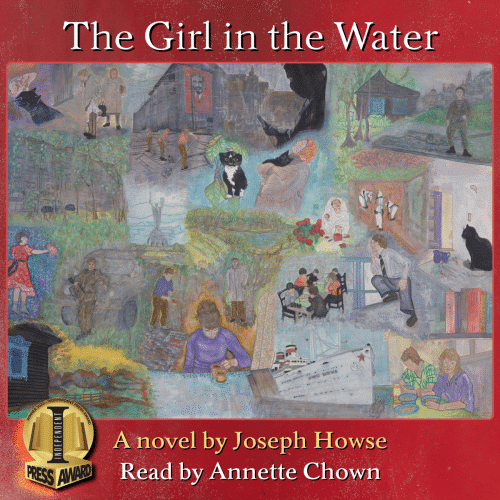
2026 Independent Press Award—Distinguished Favorite Audiobook
Four teenagers and a feral cat navigate life in Gorbachev’s USSR, in this tragicomedy set against a backdrop of civilizations in decline. The Girl in the Water has launched the award-winning series Next Year’s Snow, a multigenerational saga about innocence, survival, oppression, and choice at the flashpoints of a madly fractured world.
At the centre of this debut is Nadia, a Soviet girl who witnesses her friend’s near-drowning on a remote northern beach. Nadia is an abstract thinker coming to terms with the harsh realities around her. She is a bookworm, a prankster, a wanderer, and a note-taker. She sees people gambling with life and soul for little apparent gain and wonders what she can do to make a difference. Progressively, her life is pulled apart by her family’s migration to Ukraine, a dubious courtship, the Chernobyl disaster, police surveillance, and an Afghan war.
As Nadia comes of age, she finds that the bonds of family and friendship create an inseparable fate: to rescue one another or to drown.
-
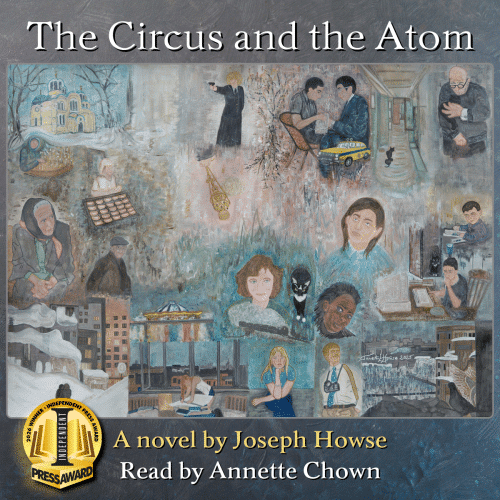
New Year 1988/1989: A theatre student, a taxi driver, a partisan, and a crook join a detective's family in Kiev for an ill-fated reunion. They and the Soviet nation face a violent reckoning as old secrets and fugitive hopes emerge.
Winner of the 2026 Independent Press Award for Literary Fiction and for World Literature
Winner of the Best of Novel prize in the 2025 Sunspot Literary Journal Solar Flare Contest
Sequel to The Girl in the Water, winner of the 2023 Independent Press Award for Literary Fiction
-
 One Hundred Years of Exile: A Romanov's Search for Her Father's Russia
 -

Imagine Electric Kool-Aid Acid Test meets Murder, She Wrote.
One part hippies grooving on the waterfront and fighting the man, one part murder mystery.It’s the 1970s, and the “houseboat wars” erupt in Sausalito on the site of Marinship, the abandoned World War II shipyard. Hippies and squatters are living free and easy on houseboats in a ramshackle shantytown, and greedy developers are determined to evict them and build new docks to attract affluent residents.
The counterculture is in full flower and the houseboaters, fearing their community will be destroyed, resist eviction with street theater, civil disobedience, monkeywrenching, and more. Like climbing into dinghies and pushing away police boats with oars. Like sinking a barge to block a pile driver. All in front of TV cameras!
Then, someone gets stabbed.
Pirates of Sausalito is fiction, but inspired by true events. As Larry Clinton, former president of the Sausalito Historical Society, said, “If it didn't happen exactly this way, it could have.”
-
 Benno Neuburger, a modest land investor from Munich and Anna Einstein daughter of a cattle dealer from Laupheim, marry in 1907. They begin their lives together with great hope. It is a relatively prosperous time and a very optimistic one for German Jews who are enjoying a social renaissance in the industrializing, urbanizing rising star that is Germany. It’s not clear that this good fortune might begin to unravel. Even as news of an assassination in an “obscure” Balkan corner of the continent passes like a cold wind through Munich on a warm beer-garden July day, people shudder but feel no great alarm. Yet what follows is a war provoked by inter-colonialist competition. It is prolonged and bloody, giving way to German defeat, revolution, a brief socialist interlude in Munich, a merciless counter revolution, and the pitiless demagoguery of defeated generals. So marks the commencement of an era of nearly relentless distress and turmoil for Germany. The lives of Benno and Anna and their extended families are amid this swirl—trying to make a life as they struggle to survive, as they cling to the hope of a peaceful resolution to crisis. But to no avail. Munich becomes the epicenter of German fascism fed by nationalist resentment and racial madness – an offspring of European rivalries and colonialism. In the 1920s the brown shirts of Germany’s former African colonial army become the uniform of a domestic legion of terror. In the 1920s Benno, Anna and their children live as close neighbors to the demagogue who will become the Nazi leader. A slow-moving horror show envelops them in the years that follow. In the 1930s and 1940s: Emigrating children, a pogrom, a new war, evictions, “resettlement” via a train ride east . . . desperate acts of resistance, arrest, trial – as the holocaust plays out— all up close and personal: A human story told through the voices of those who lived it.
 -

Follow the paths of Sarah and Will (or Sam) as they tell their stories of trust, secrets, and betrayal on the frontier in the old West. Their pioneer spirit helped to fuel the expansion into the Western territories of the United States. The two are historically on their separate journeys, yet they remain intimately connected. Through the fictionalized Western frontier tale of Sam and Sarah, the author, Beverly Scott, was inspired to reveal rumored secrets from her family history. In 1878, Will is on the run after killing a man in a barroom gunfight. He escapes the Texas Rangers by joining a cattle drive as a cook headed to Dodge City. He struggles with the dilemma of saving his life or attempting to return to his pregnant wife and five children. Just when he thinks he might be able to return home, he is confronted by a bounty hunter who captures him and plans to return him to Fort Worth, Texas to be hanged. Although Will changes his name to Sam, he remains an irresponsible, lonely and untrustworthy man on the dodge from the law who abandons the women he loves. He ultimately seeks redemption and marries Sarah. In 1911, Sarah, a pioneer woman and a widow with five children, struggles to find the inner strength to overcome betrayal, loneliness, fears, and self-doubt. Her husband, Sam, thirty years her senior, died with a mysterious and defiant declaration, “I won’t answer!”. Despite poverty and a crippling illness, she draws on her pioneer spirit to hold her family together and return to Nebraska to be near her parents and siblings. When Sarah returns to Nebraska she receives staggering news which complicates her efforts to support her children. She is shocked, angry and emotionally devastated. Since she is attempting to establish herself in the community as a teacher, she believes she must keep her secret even from her own family. Will Sarah find forgiveness in her heart and the resolve to accept her new life alone?
-
 Have you been a seventh grader, taught or parented one? Then you’re guaranteed to laugh as the new female vice principal faces hormonally charged middle schoolers, demanding parents, an obnoxious boss, and clueless teachers. Ride the roller coaster of the new job and cheer for Cynthia Walker as she dives into the hilarity and angst of working with tweens. Watch her deal with bomb threats, fire, and pythons on the loose. Bullied kids and abusive parents. Dysfunctional homes, charges of racial bias, and a touchy-feely principal who demands her attention but provides no guidance. And she would like to date the handsome and talented history teacher, if only she weren’t his supervisor. Schooled will take you back to your own school days. This page-turner will open your eyes to the challenges of public education, the job satisfaction to be found by educators who care, and the type of leader you want to guide your children.
 -
 Searching For Monkumar: A Mystical Tale About Finding Freedom, Friendship, And Spirituality


